Tribal Knowledge Is Not a Screening Policy
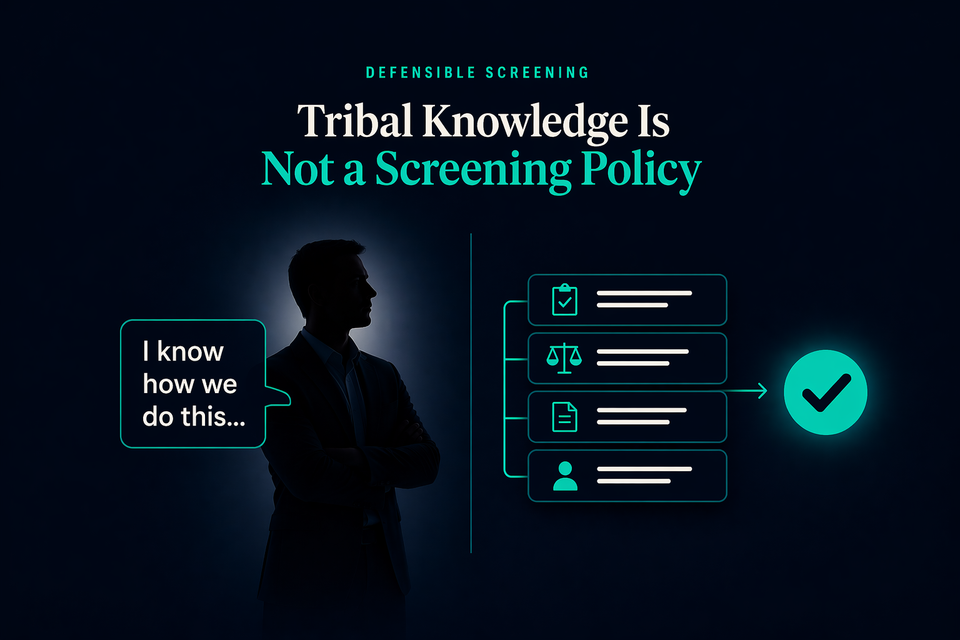
Most operators think they have a screening policy. What they have is a person. And those are not the same thing.
A real policy exists outside of any individual. It's written before the first application is submitted, applied consistently regardless of who's reviewing the file, and produces an outcome that can be explained after the fact. Most screening processes don't meet that standard. They live in the heads of the people running them, shaped by experience, refined through repetition, and trusted because they've "always handled it that way."
That works right up until it doesn't.
The Translation Layer Nobody Documented
Every team has someone who just "gets it". They know how to read a borderline credit file. They know when a criminal history is genuinely disqualifying versus when context matters. They know the line between "approved with conditions" and "this one's a no." Over time, that judgment becomes the de facto standard. Not because anyone defined it, but because it was consistently applied by the same person.
The organization starts to confuse reliability with structure.
But what exists isn't a policy. It's a translation layer. It works as long as the person doing the translating is there to run it. The moment they leave (for another job, for a promotion, for any reason), the logic leaves with them. The way exceptions were handled disappears. The consistency everyone relied on breaks quietly, usually before anyone notices.
What remains is a decision history with no explanation attached to it.
Where the Exposure Actually Lives
Screening decisions are rarely challenged when they're made. Challenges come later. In a fair housing complaint. During an internal review. When a regulator asks why two applicants with similar profiles received different outcomes six months apart.
At that point, the question isn't whether you intended to be consistent. It's whether you can show that you were.
Most operators can't.
Because nothing was written down before applications started coming in. No pre-defined criteria. No documented exception process. No standard that lives outside the person who was applying it.
This becomes especially real around adverse action. Every denial you've issued carries obligations under FCRA Section 615, and if it's ever challenged under fair housing law, you'll need to show the decision was based on consistent criteria applied the same way across applicants. If your actual process relied on one person's judgment, that claim starts to fall apart under scrutiny. You can't demonstrate consistency. You can't show that the same standard applied to applicant A also applied to applicant B. And if the person who made those calls is gone, you can't even reconstruct the reasoning.
That's not a hypothetical. That's a real gap in defensibility that shows up when someone decides to push back.
The Exception Problem
This is where smaller operators tend to underestimate their exposure: the undocumented exception.
Every screening process has them. The applicant who was slightly under the income threshold but had a strong rental history and got approved anyway. The one with a criminal record that was outside the normal lookback window but close enough that someone made a call. The borderline credit file that got a second look because vacancy was trending high.
None of that is inherently wrong. Exceptions happen. And in some jurisdictions, particularly those with Fair Chance Housing ordinances, operators are required to conduct individualized assessments of criminal history rather than applying categorical rules. What those assessments must include varies by jurisdiction.
The problem isn't the exception. It's that nobody wrote it down. So it wasn't, and couldn't be, applied consistently.
When an exception goes undocumented, it becomes evidence of inconsistency rather than evidence of good judgment. The next applicant in a similar situation who doesn't get the same exception now has a comparison point. And if the exception logic lived entirely in the head of someone who's no longer there, you can't explain the difference. You can't show it was applied fairly. You can't demonstrate that protected class status had nothing to do with who got the benefit of the doubt.
Documentation doesn't eliminate exceptions. It makes them defensible.
What You're Actually Building
A written screening policy isn't a compliance binder or a 20-page manual nobody reads. It's a clear statement of how decisions get made → worked out before any application comes in.
At minimum, it defines what factors are considered (income-to-rent ratio, credit history, rental history, criminal background), how each factor is evaluated (what thresholds matter, what lookback periods apply), what outcomes those factors produce, and how exceptions are handled when they arise. That last piece is the one most policies skip. A policy that defines criteria but leaves exceptions to individual discretion hasn't solved the problem; it's just moved it.
The policy should also exist before screening begins, not get constructed afterward to explain a decision already made. That distinction matters more than people realize. A pre-application standard is a policy. A post-hoc explanation is a story.
And stories don't hold up when someone is actually pushing back.
The Smaller Operator Blind Spot
Smaller operators often assume this doesn't apply to them. The logic goes: we're not a big REIT, we don't have thousands of applicants, the stakes are lower.
But the exposure doesn't scale with size. If anything, it's worse at lower volume.
Fewer people means more responsibility sits with individual reviewers. Less formal structure means more room for variation. Limited documentation means there's very little to fall back on when a decision gets questioned.
I've talked to operators who, when asked how they'd explain a denial if it were challenged, paused and said "I'd call the person who handled it." That person left eight months ago. Low volume makes inconsistency feel manageable until scrutiny makes it visible.
The smaller the operation, the more likely a single person IS the policy. And the more exposed you are when that person isn't there anymore.
Defensibility Starts Before the Application
The time to build a written screening policy is not after a complaint is filed. It's not after the person who ran your process for three years puts in their notice. It's before the first application hits your inbox.
Most operators spend their energy trying to make better screening decisions. Better data, better tools, more layers, sharper judgment. That matters. But it's not where the real exposure sits.
The exposure shows up later, when the decision has to be explained to someone who wasn't in the room. That consistency, criteria defined in advance, applied the same way, documented when exceptions occur, is what separates a defensible decision from an explainable guess.
If that explanation depends on who made the call, you don't have a system.
You have a person pretending to be one. And when that person is gone, so is your defensibility.
This is educational content, not legal advice. Screening obligations vary by jurisdiction. Consult qualified counsel for guidance specific to your operations.