Your Unscorable Problem Isn't the Applicant's Fault. It's the Models.
A 26-year-old nurse applies for an apartment at one of your communities. She has a stable job, a clean background, and three years of on-time rent payments at her current unit. But she's a cash buyer. Your screening system returns a single word: unscorable.
She is declined. The unit sits vacant for another 11 days, and you had to screen two more applicants to fill it.
Nothing about her was risky. The screening model just couldn't see her.
The Numbers Have Changed. The Defaults Haven't.
In June 2025, the CFPB issued a major correction to its credit invisibility estimates. The original 2015 report pegged credit invisibles at 26 million Americans. The corrected number: 13.5 million (a methodological error had nearly doubled the original count). By 2020, the actual credit invisible population had dropped further to about 7 million, or 2.7% of adults.
But here's the number that matters more for rental operators: as of 2020, 25.3 million Americans were unscorable. They have a credit file. It just doesn't contain enough tradelines or recent enough activity to generate a standard credit score. That's 9.8% of the adult population.
These people aren't invisible. They're visible. Your model just doesn't know what to do with them.
Red Flag vs. Information Gap
Most screening systems treat a thin file the same way they treat a derogatory mark: as a reason to say no. The applicant either generates a score or they don't. If they don't, the system returns an unscorable result, and the operator's policy takes over. At most properties, that means an adverse action letter and more screenings.
That's a design choice. Not an inevitability.
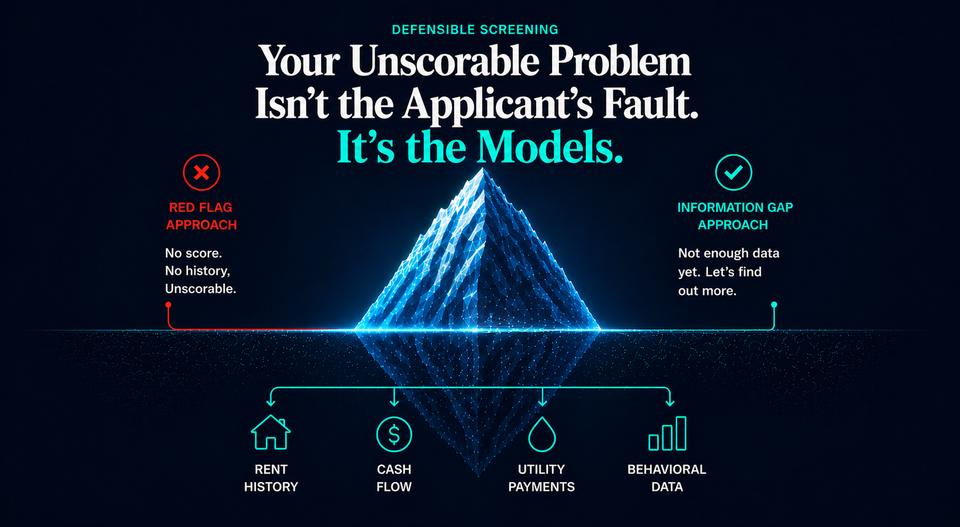
There are two ways to interpret the absence of a credit score:
Red flag approach: No score means no verifiable history. No verifiable history means elevated risk. Decline.
Information gap approach: No score means the data sources currently in the model are insufficient to assess this applicant. The system should attempt to close the gap before returning a result.
The first model treats screening as a filter. The second treats it as a decision tool. And the gap between them shows up in your occupancy rate, your screening spend, and your fair housing exposure.
What the Red Flag Approach Actually Costs You
When your screening process auto-declines unscorable applicants, here's what actually happens:
Double screening cost. Every declined applicant means at least one additional screen to fill that unit. If your unscorable rate is 15%, you are paying for up to 15% more screens than you need to, before accounting for the operational time behind each one.
Longer vacancy cycles. Each additional screen can add days or weeks. Tours, applications, processing, decisioning. For a unit renting at $1,800/month, every additional week of vacancy costs roughly $450 in lost revenue. Multiply that across your portfolio.
Missed residents who would have performed well. TransUnion's study of new-to-credit consumers found that they perform as well as, or better than, established credit users over a two-year observation period across lending products. The rental parallel holds: if someone pays their debts reliably with no prior credit history, the thin file was the model's limitation, not the applicant's.
Fair housing exposure. Credit invisibility isn't evenly distributed. According to the CFPB's research, about 15% of Black and Hispanic consumers are credit invisible compared to 9% of White consumers, and an additional 13% of Black consumers and 12% of Hispanic consumers have unscorable records compared to 7% of White consumers. These gaps show up early in adult life and persist.
A blanket decline policy for thin files can create a pattern of adverse impact on protected classes. The Fair Housing Act's disparate impact framework has historically made intent irrelevant; the pattern is what matters. That regulatory framework is currently under significant federal pressure though: in January 2026, HUD proposed eliminating its disparate impact regulations entirely. Whether or not that rule is finalized, the underlying statute remains intact. Operators relying on thin-file blanket denials should not treat the regulatory uncertainty as a green light. Private litigation risk remains.
What Closing the Gap Might Look Like
Closing the gap doesn't mean approving every unscorable applicant. It means your system does more work before returning a result.
Separate fraud detection from credit assessment.
A thin file can be a fraud signal. Synthetic identities often present as thin files. But it can also be a 22-year-old with a debit card and a clean rental history. When fraud and credit risk decisions are entangled in the same score, every thin file gets treated like a synthetic, and most of them aren't. Verify identity first. Then assess creditworthiness. The fraud layer should catch the synthetics. The credit layer shouldn't penalize everyone else for their existence.
Use scoring models built for renters, not borrowers.
Traditional credit scores were designed to predict debt repayment on revolving credit. Not rent performance. Renter-specific scoring models exist that incorporate eviction history, rental payment patterns, and behavioral data that traditional scores ignore. These models score a larger share of the applicant population because they draw from a wider data set. If your screening provider can't tell you what their model was built to predict, that's worth a conversation.
Incorporate alternative data that reflects actual rent-paying behavior.
When rent payment tradelines are added to credit files, 9% of previously unscorable consumers become scorable, with an average score of 631. Consumers with reported rent payments see an average credit score increase of nearly 60 points. And when rental tradelines are included in predictive models, delinquency prediction improves by more than 10%.
That's not marginal. That's the difference between a system that can assess 85% of your applicants and one that can assess 95%.
Cash flow data, rent payment history, utility payments: the alternative data landscape for rental screening is broader now than it was just a few years ago. The infrastructure to close the information gap exists. The question is whether your process is set up to use it.
Build a documented thin-file workflow.
If an applicant comes back unscorable after your primary screen, your process shouldn't end there. Define what happens next.
Start with documentation from the applicant's current housing situation. Request proof of on-time rental payments from their current landlord, or accept utility, phone, or insurance payment history as supplementary verification. If you're pulling that data from a third-party source rather than documents the applicant provides, confirm with your screening provider that it's FCRA-compliant. Third-party data pulls may trigger consumer report obligations, including adverse action notice requirements.
If you offer conditional approval with a higher deposit, ensure the criteria are documented, consistently applied, and reviewed for disparate impact. Where your process requires human judgment, route to manual review with documented criteria, not ad hoc decisions.
The key word is documented. A defensible process can be explained, audited, and applied consistently. "We decline all thin files" is a policy. But without documentation of business necessity and consistent application, it's difficult to defend under Fair Housing Act disparate impact analysis.
Measure your unscorable rate like a KPI.
If you don't know your unscorable rate, you can't manage it. Track it monthly, by property and by market. If it swings wildly across your portfolio, that tells you something about data quality, not applicant quality.
The Industry Is Moving. The Question Is Whether You Are.
The broader credit ecosystem is actively adjusting to account for consumers with thin files and unscored records. The FHFA's July 2025 directive allowing Fannie Mae and Freddie Mac to accept alternative credit scoring models is one marker of that shift. The move reflects a recognition that traditional scoring models leave a meaningful share of creditworthy consumers unassessed, and that rent payment history is legitimate credit data, not a gap to be penalized.
Rental screening is part of that same ecosystem. The infrastructure to score thin-file applicants more accurately exists and is expanding. The question for operators isn't whether the industry is moving. It's whether your screening process is.
Screening systems that still treat thin files as dead ends aren't being conservative. They're just incomplete.
A thin file can be a red flag. It can also be your next best resident. The difference is whether your screening process is designed to tell them apart.
Sources:
- CFPB, "Technical Correction and Update to the CFPB's Credit Invisibles Estimate," June 2025
- TransUnion, "New TransUnion Study Finds Millions of New-to-Credit Consumers Prove to Be Similar If Not Better Risks Than Established Credit Users"
- TransUnion, "Alternative Data Such as Rent Payment Reporting Bridges the Gap for Unscorable Consumers"
- TransUnion, "More Consumers Likely Self-Reporting Rent Payments in 2025"
- TransUnion, "Rent Payment History Offers Greater Predictability into Consumer Credit Performance"
- FHFA, "VantageScore 4.0 Allowed for Use on All Fannie Mae and Freddie Mac Mortgages," July 2025
- CFPB, "Who Are the Credit Invisibles?" December 2016
Disclaimer: This is educational content, not legal or compliance advice. Screening laws and obligations vary by jurisdiction and change frequently. Nothing here should be relied upon as guidance specific to your operations. Consult qualified legal counsel before making screening policy decisions.